
*Disclaimer: This is the second part of a two-part series on the Lethal Trifecta. If you haven't already read about what the lethal trifecta is and how it works, we recommend starting here.
The Only Solution: Architectural Boundaries
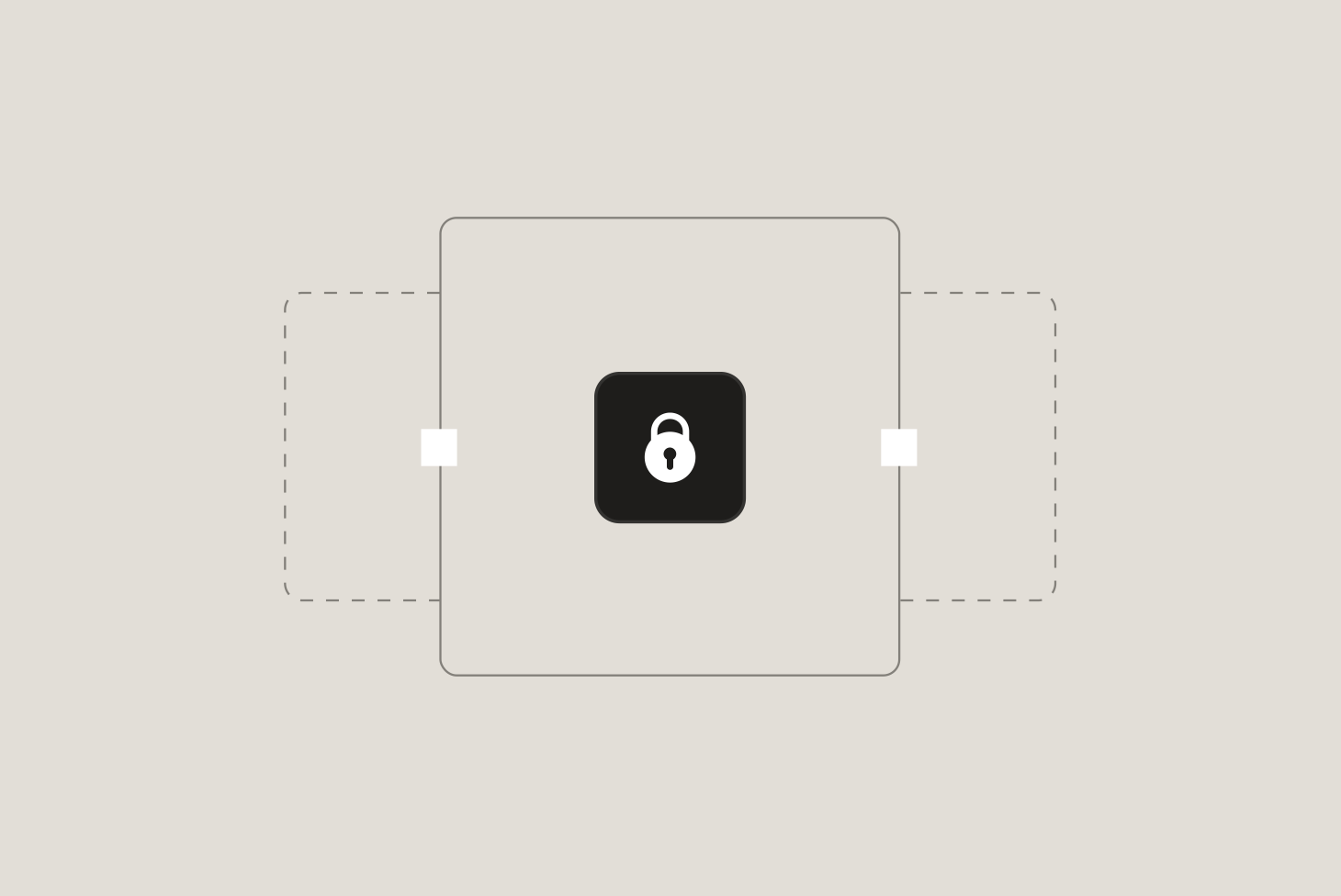
The Lethal Trifecta can only be addressed through infrastructure-level security that prevents the AI from even having the capability to execute the attack.
This is where PopdockAI’s seven-layer security architecture becomes essential. This isn’t just a “nice-to-have" feature; it is a fundamental requirement for safe AI deployment.
Break the Trifecta Through Separation
The solution is simple; we make it so you can only mix two of the three components. Instead of giving one AI agent access to all three capabilities, you enforce separation:
Agents handling public data (tickets, emails) cannot access sensitive internal data. They operate with heavily restricted permissions, seeing only the information appropriate for external communication.
Agents with access to sensitive data cannot write to public channels. They can only output to internal systems where data is contained within your security perimeter.
Different roles for different contexts. A support agent AI gets customer-facing data access. An internal analytics AI gets sensitive data access, but no external write permissions. No single agent has all three components of the Lethal Trifecta.
This separation happens at the infrastructure layer:
Role assignments: Different AI agents or contexts receive different role assignments. Your support chatbot operates under a "Public Support" role that cannot access employee records, financial data, or internal systems.
Row-level filters: Even within allowed data sources, row-level filters ensure the AI only sees records appropriate for its context. A customer-facing agent sees only data about the specific customer making the request.
Hidden fields: Sensitive fields are completely hidden from agents that shouldn't access them. The AI doesn't just avoid sharing them, it simply never knows they exist.
Parameter Validation: Attempts to craft queries that bypass restrictions are caught and rejected before reaching data sources.
In-depth auditing: Every access is logged with full context, creating accountability and enabling detection of attempted exfiltration.
Real-World Implementation
Here's how this works in practice:
Customer Support Scenario:
Agent Role: "Customer Support Bot"
Data Access: Customer tickets, account information (name, email, order history)
Blocked Access: Financial data, internal notes, employee information, all other customer records
Write Permissions: Can update ticket status, add customer-facing comments
Cannot Write To: Internal notes fields, financial systems, employee databases, other users’ tickets.
Even if a prompt injection attack successfully manipulates the AI's behavior and it attempts to access financial data or write to internal fields, the infrastructure layer blocks the request. The AI cannot exfiltrate what cannot be accessed.
Internal Analytics Scenario:
Agent Role: "Business Intelligence Analyst"
Data Access: Full financial data, sales pipeline, employee metrics, proprietary algorithms
Write Permissions: Internal dashboards, reports, databases
Cannot Write To: Email, ticketing systems, any external channels
This agent has the sensitive data access it needs to provide valuable insights, but it physically cannot write that information to any channel accessible from outside your organization.
Why This Matters Now
The Lethal Trifecta isn't a theoretical vulnerability. It's an active risk that grows as organizations deploy more AI agents with broader access. Consider:
1.) How many of your AI tools can read both customer communications and internal data?
2.) How many can write responses to external channels?
3.) If someone crafted a malicious ticket or email, what internal information could they potentially extract?
The uncomfortable truth is that without architectural boundaries, the answer to that last question is often "all of it."
Traditional security approaches fail here because:
Perimeter security doesn't help. The AI is inside the perimeter with legitimate credentials.
Authentication doesn't help. The AI is properly authenticated, that's not the issue.
Encryption doesn't help. The AI needs decrypted data to function.
Prompt engineering doesn't help. You cannot reliably instruct an AI to never be manipulated.
The Bottom Line
When you give an AI agent the ability to read public data, read sensitive data, and write externally, you've created a data exfiltration channel. The only question is whether someone will find it before you close it.
Closing it requires breaking the Lethal Trifecta through infrastructure-level controls:
1.) Separate AI agents by context and permission level
2.) Enforce role-based access that prevents any single agent from having all three capabilities
3.) Implement row and field-level security that limits data exposure
4.) Validate all inputs and queries before they reach backend systems
5.) Audit everything to detect exfiltration attempts
These controls must exist outside the AI's control, at the infrastructure layer. You're not trusting the AI to follow instructions, you're making it architecturally impossible for it to execute the attack.
PopdockAI's seven-layer security architecture was built specifically to address this problem. Not because we're paranoid, but because we understand what happens when AI agents can read anything and write anywhere.
The Lethal Trifecta is real. The only question is whether you'll address it before it becomes a breach. Contact us to get started with PopdockAI, and protect your data against prompt injection attacks and the lethal trifecta.
PopdockAI, which had been available for limited release since October 2025 for customers and partners with special use cases, is now rolling out to the general public.

popdock gets your data out. popdock-manage builds the setup that makes that data reachable. Here's why they're separate tools, and when to reach for each.
Web UI vs. CLI. To an AI agent, this is the difference between a task that costs a few thousand tokens and one that costs a few hundred thousand.
From AI Potential to AI Performance in Minutes
One layer.
All your apps.
Any AI tool.
Join forward-thinking companies that are transforming their operations with intelligent, secure AI automation.