Resources Favorite
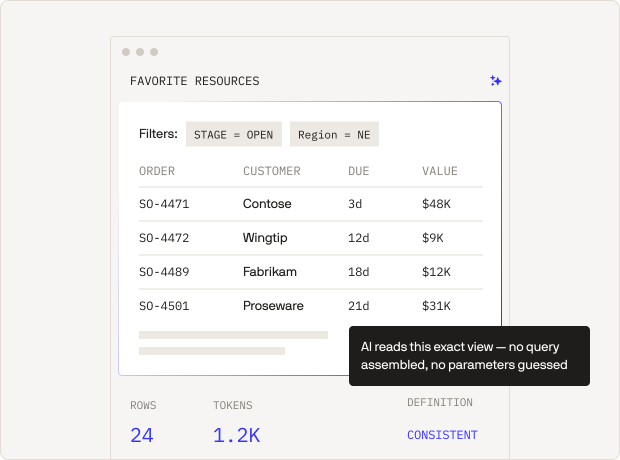
Your team has already worked out which view of the data is the right one. Publish that saved view as a resource and AI reads the curated answer directly, with the filters, sorting, and columns your business decided on.
Curated Answers, Not Open-Ended Queries
The View Is the Definition
Half the work of a good answer is deciding what to leave out.
Publish the decision, not the query
A favorite already carries its filters, its sort order, and its chosen columns. Publishing it as a resource means AI reads the view your team validated, instead of assembling a query and hoping it matches what people meant.
>
Filters, sorting, and column selection travel with the view
>
No parameters for AI to fill in incorrectly
>
The definition of "our open orders" stays consistent for everyone
>
Business logic stays with the people who own it
Reuse What Your Team Already Built
The best reference data in your business is already saved somewhere.
Nothing new to model
Pick a connector, pick the list, pick the favorite. If the view exists in PopdockAI, it can be published as a resource in under a minute, with no fields to map and no queries to write.
>
Choose from the favorites your team already maintains
>
Works across every connected system
>
No new modeling, mapping, or query authoring
>
Publish in a minute, not an afternoon
Change the View, Change Every Answer
Reference data that cannot evolve gets abandoned.
One edit, everywhere
Adjust the favorite and every conversation that reads the resource picks up the new definition. When "priority accounts" gains a fourth criterion, nobody has to be told twice.
>
Edits to the view flow through immediately
>
One place to maintain, not one per team
>
No client-side configuration to update
>
Consistent answers across every AI client
Ensure Security and Adaptability
in Any Environment
[01]
Boundaries That Hold
A curated view is only safe if the wrong people cannot read it.
Governance at the resource
Access is granted per resource, by user, or by team, and MCP clients can be limited to the resources they are permitted to read. A view built for the leadership team stays with the leadership team.
>
Edits to the view flow through immediately
>
One place to maintain, not one per team
>
No client-side configuration to update
>
Consistent answers across every AI client
[02]
Predictable Cost and Volume
Open-ended querying is how a helpful assistant becomes an expensive one.
Bounded by design
A favorite has a defined shape. Because the view sets its own scope, reads stay predictable in size and cost, and your source systems are never asked an unbounded question.
>
The view's own scope caps what gets returned
>
No surprise full-table reads
>
Predictable response sizes across clients
>
Source systems stay responsive under load
[03]
Versions and Read History
Curated views get revised, and revisions need a record.
Nothing changes silently
Draft a change to the resource, publish it when it is right, and roll back if it is not. Every read is logged with the user, the client, and the timestamp.
>
Draft, publish, and rollback on every resource
>
Version notes explaining each change
>
Per-resource read history
>
Full audit trail for reporting
Real-World Applications
Sales Teams

The saved pipeline view is read as published: territory already filtered, stages already ordered, and only the columns the team cares about.
Finance Departments

The aged receivables favorite is read exactly as finance defined it, so "overdue" means the same thing in every conversation it appears in.
Support Operations

The team's open ticket view is published once, so priority ordering and queue filtering are already correct before AI ever sees the data.
Operations and Inventory

The reorder view is read with its own thresholds applied, so the answer reflects the reorder policy operations actually set.
Built for Scale,
Designed for Simplicity
Publish the views your business already trusts and let every team read them through the assistant they already use. As your definitions evolve, edit the favorite and every conversation follows. As new teams come on board, publish the views they need without rebuilding anything.
Your curated data becomes as accessible as asking a question, as consistent as the view behind it, and as governed as the rest of your business systems.